One person's work
Use a personal agent
Claude Cowork, OpenAI's dots, Muse from Meta, or Grok Bot. One person delegates the research, documents, or errands, steers the work, and owns the result.
Compare personal agents →A personal agent works for one person. Boring runs the work your company answers for: a business event starts it, it acts only through the actions you grant, an assigned teammate approves or corrects the sensitive steps, and every run leaves one reviewable record.
Personal agents now work in the background and ask before risky steps. When the work is yours, use one. Boring is for the work your company answers for: owned by a team rather than one person, started by business events, and reviewable after every run.
One person's work
Claude Cowork, OpenAI's dots, Muse from Meta, or Grok Bot. One person delegates the research, documents, or errands, steers the work, and owns the result.
Compare personal agents →Predictable app-to-app plumbing
When X happens, do Y. If no step needs judgment, a fixed graph in Zapier, n8n, or Make is simpler, faster, and easier to predict.
Compare workflow builders →Work your company answers for
The work belongs to the business, not to whoever set it up. An event starts it, it acts only through granted actions, an assigned teammate approves or fixes the sensitive step, and every run stays reviewable.
See the workflow →A business event starts it. The agent works within its brief, pauses for an assigned teammate at the sensitive step, then resumes and leaves one complete run record.
Everything an agent needs to do the work. Everything your team needs to stay in control.
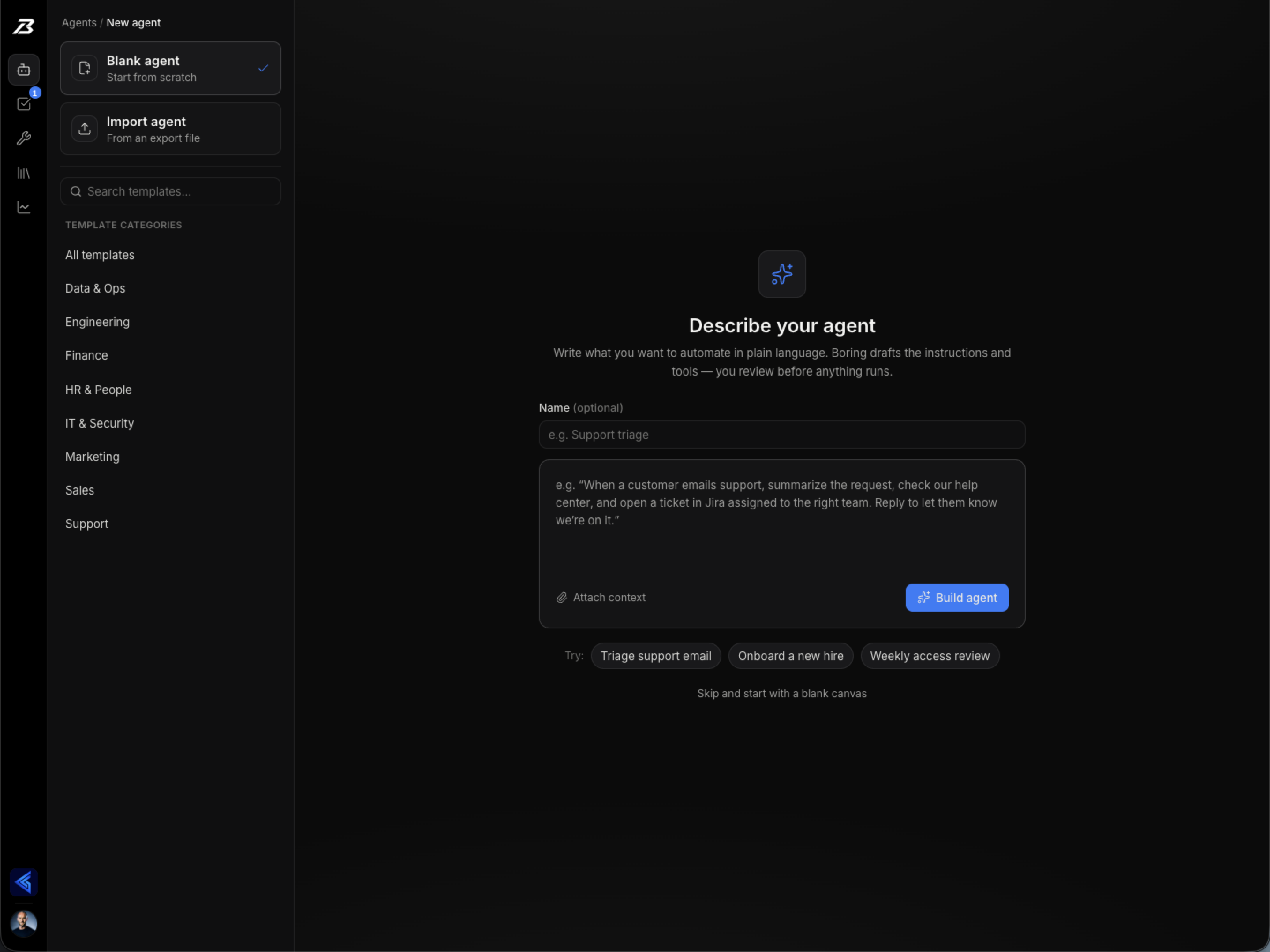
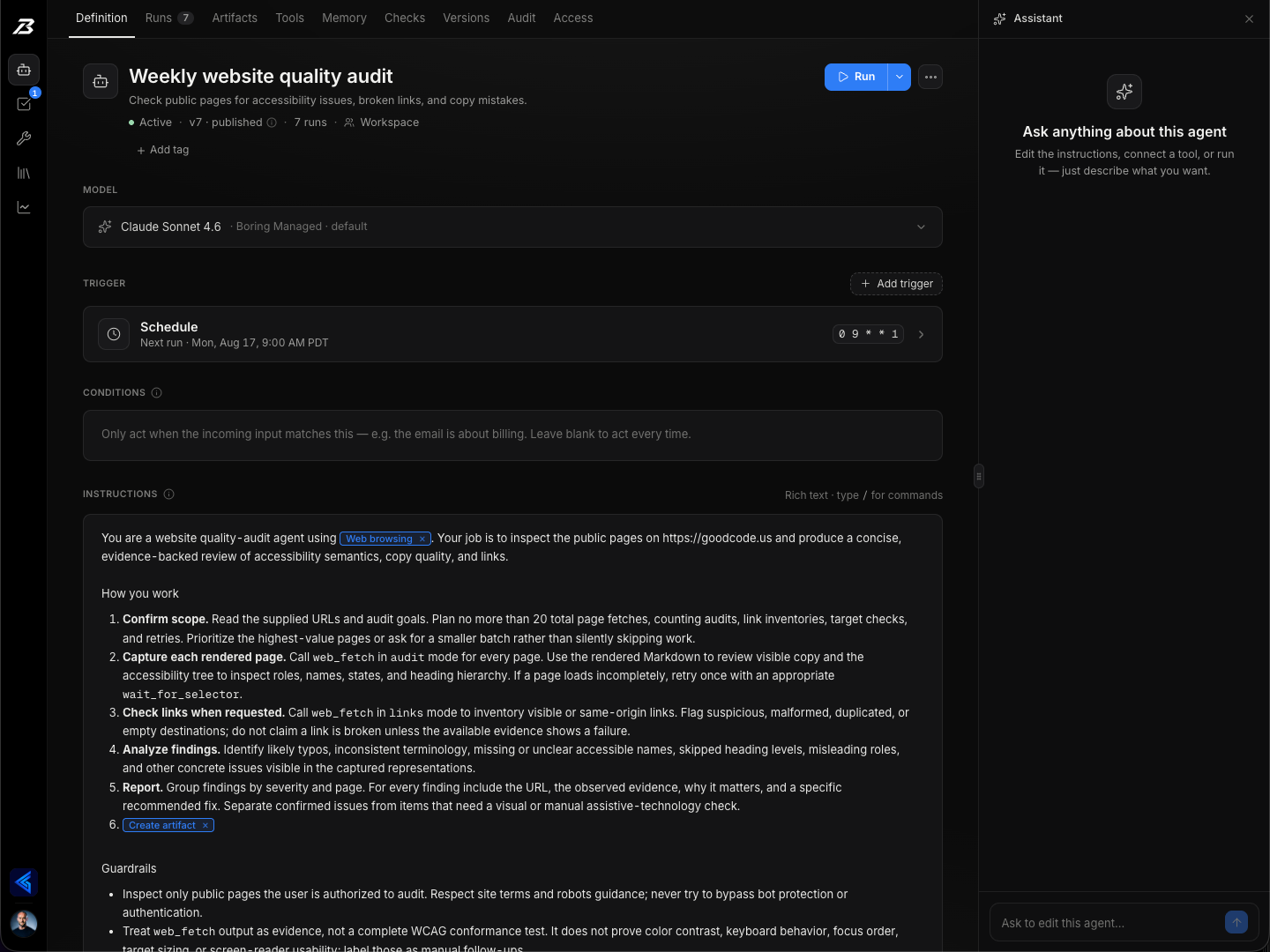
Describe the work, connect the right tools, and give your team a playbook they can shape together.
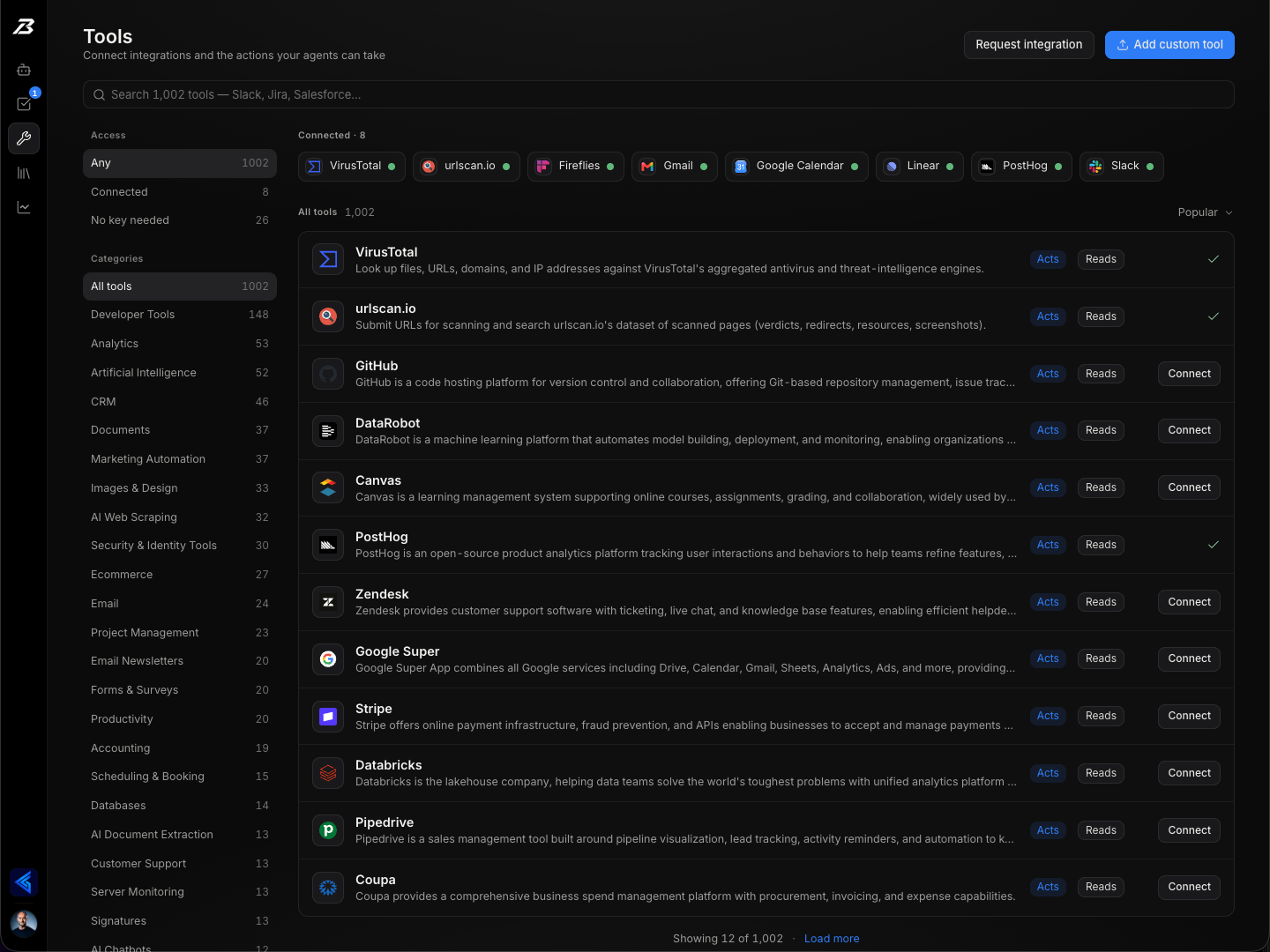
Connect the apps your work already runs on, plus guarded first-party tool packs. Choose the exact actions each agent can use.
Use Boring-managed with no setup: Claude Sonnet 5.5 by default, or GPT, Gemini, and Grok with no key. Lower-cost open-weight models are rolling out. Or bring your own Anthropic, OpenAI, Google, OpenRouter, or compatible-endpoint key.
Turn plain-language instructions into an editable playbook. Review the draft and explicitly publish when it is ready.
Delegate a task to another agent in the same workspace, wait for its result, and continue with that output. Linked runs, depth limits, and cycle checks keep delegation bounded.
Schedules, webhooks, inbound email, public forms, app events, the Chrome extension, the workspace API, MCP clients, and other agents can all start the same playbook.
Build Boring into your own systems. Manage agents, start runs, and retrieve results through a workspace-scoped REST API, with an OpenAPI spec generated from the same route schemas.
Import an OpenAPI 3.x document or connect a token-authenticated remote MCP server, review the discovered actions, and attach the toolkit to the agents that need it.
Edit instructions together with live presence and cursors. A visible autosave fallback keeps drafts editable if the live room is unavailable.
Browse first-party agent templates and adapt a starter playbook to your team. Each starts as a private draft for you to connect, review, test, and publish.
Build an intake form with text, email, dates, and choice fields. Share its public URL and turn submissions into agent runs with the submitted context.
An interviewer explores your recurring work, suggests directions, and turns your chosen idea into a private agent draft.
Control what an agent can reach, which actions it can take, and where its credentials live.
A private credential service handles authenticated requests. The engine receives short-lived, revocable access tied to the run, workspace, and agent version.
Grant only the read and write actions an agent needs. The runtime enforces the list: a withheld action is never offered to the agent and cannot run. Connecting an app does not grant unrestricted access to it.
Connect several named accounts for the same app or custom integration, keep each private or shared, and pin each agent to one. If a pinned account is removed or expires, the run stops instead of switching accounts.
When an agent holds a broad app grant, the assistant suggests narrowing it to the exact actions its instructions and recent successful runs use. Each action is checked against the live catalog, and a manager applies the change.
Tool access checks current connections and requester permissions. Expired or revoked run access blocks subsequent authorized requests.
Run calculations in a fresh, bounded sandbox. No network, credentials, packages, or host access; only that run’s output files are available. Python is standard library only.
Known credential values are redacted from returned content and errors, including secret echoes split across streaming responses.
TLS protects data in transit. Credentials Boring stores directly use an encrypted workspace vault.
We never train foundation models on your content, and we never sell your data.
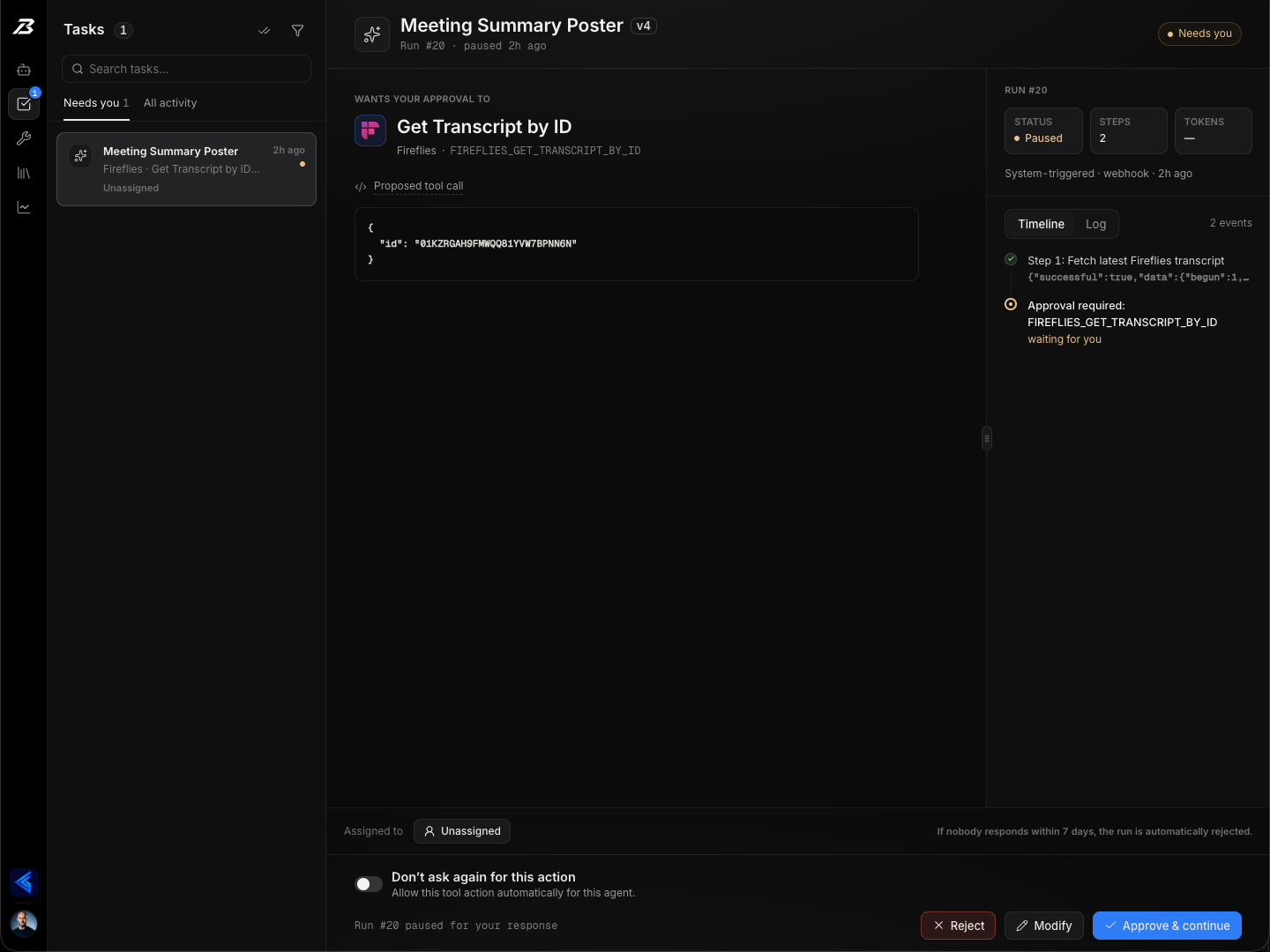
Send each sensitive step to the right person with the exact proposed action, a due date, and reminders. They approve it, change it, or stop it, and the runtime enforces the gate, not the prompt.
A gated action waits for its reviewer with the exact tool call and scrubbed arguments up front. Approve it or edit the arguments, and the run picks up where it paused; reject it, and the run stops. Approve or reject from the mobile companion too.
New agents start with every connected action waiting for approval, so loosening that is a deliberate choice. When Boring can’t tell whether an action only reads, it treats the action as a write.
Press ⌘J or Ctrl+J anywhere in the web console. Ask which agents need attention, what is waiting on a person, or where the spend went. It reads run evidence before diagnosing, sees only agents you can access, and changes nothing until you confirm.
Assign and reassign reviewers, set due dates and reminders, and choose what happens when an approval is still waiting after its due date: reject it and stop the run, or skip the action and continue.
Control who can build, run, and approve. Set each agent to pause before all calls, write actions only, or none, and mark an eligible call “Don’t ask again” while you approve it.
Tool approvals show the exact proposed action and scrubbed arguments; sign-off requests open the full request before you approve. Each click is checked against your linked Boring account. Editing a call happens in the console; typed-input requests are answered in the console or mobile companion.
The native iOS and Android companion supports approvals, human-input requests, live runs, stop and retry, and workspace usage.
Pause to collect feedback or missing context from a person, then continue with the human response in context.
See the agent’s permitted tools, limits, waits, retries, stops, and notification routes. The control inspector distinguishes enforced limits from model-judged behavior.
Saved progress, enforced step order, bounded retries, and shared limits keep failures from turning into repeated work or runaway execution.
Structured runs save their plan, progress, and action outcomes. Resume an eligible failed run from the last completed step; when an action’s outcome is uncertain, Boring blocks automatic repetition instead of guessing.
Numbered instructions run as an enforced plan: one step at a time, with later steps withheld until the agent reaches them. Each step must be marked complete, with any evidence you require, before the next begins.
When a model provider throttles or fails, eligible runs wait within a bounded window, honor its cooldown, and don’t repeat completed work. If the provider stays down, the run ends with its saved progress and a clear reason.
Your plan’s workspace and per-run spend limits constrain model spend. Billed failed attempts count toward the run ceiling before another request is admitted.
Set a per-run maximum, daily and billing-period workspace budgets, and a pause switch. Each model request, including the assistant, drafting, checks, and calls on your own keys, reserves against them before it is sent. Budgets cover Boring’s recorded model usage, not provider invoices.
Shared workspace and agent limits bound active execution and accepted queued work. Human waits release capacity for other runs.
A schedule pauses after five consecutive failures until you re-enable it, giving your team time to fix the underlying problem.
Full input schemas guide tool calls. Supported format corrections and a bounded repair attempt address invalid arguments while preserving unrelated valid fields. Reviewed, version-matched tool guidance helps avoid known mistakes; inputs are checked before execution.
Built-in checks flag setup and instruction issues. After publication, an AI quality review can suggest fixes for ambiguity; your team reviews and applies the changes.
Try unpublished changes with a one-off draft run while scheduled work keeps using the published version. Draft runs use real tools; Confidence checks provide recorded replay.
Confidence checks replay successful runs against a draft with live tools blocked. Inspect changed tool calls, arguments, and approvals.
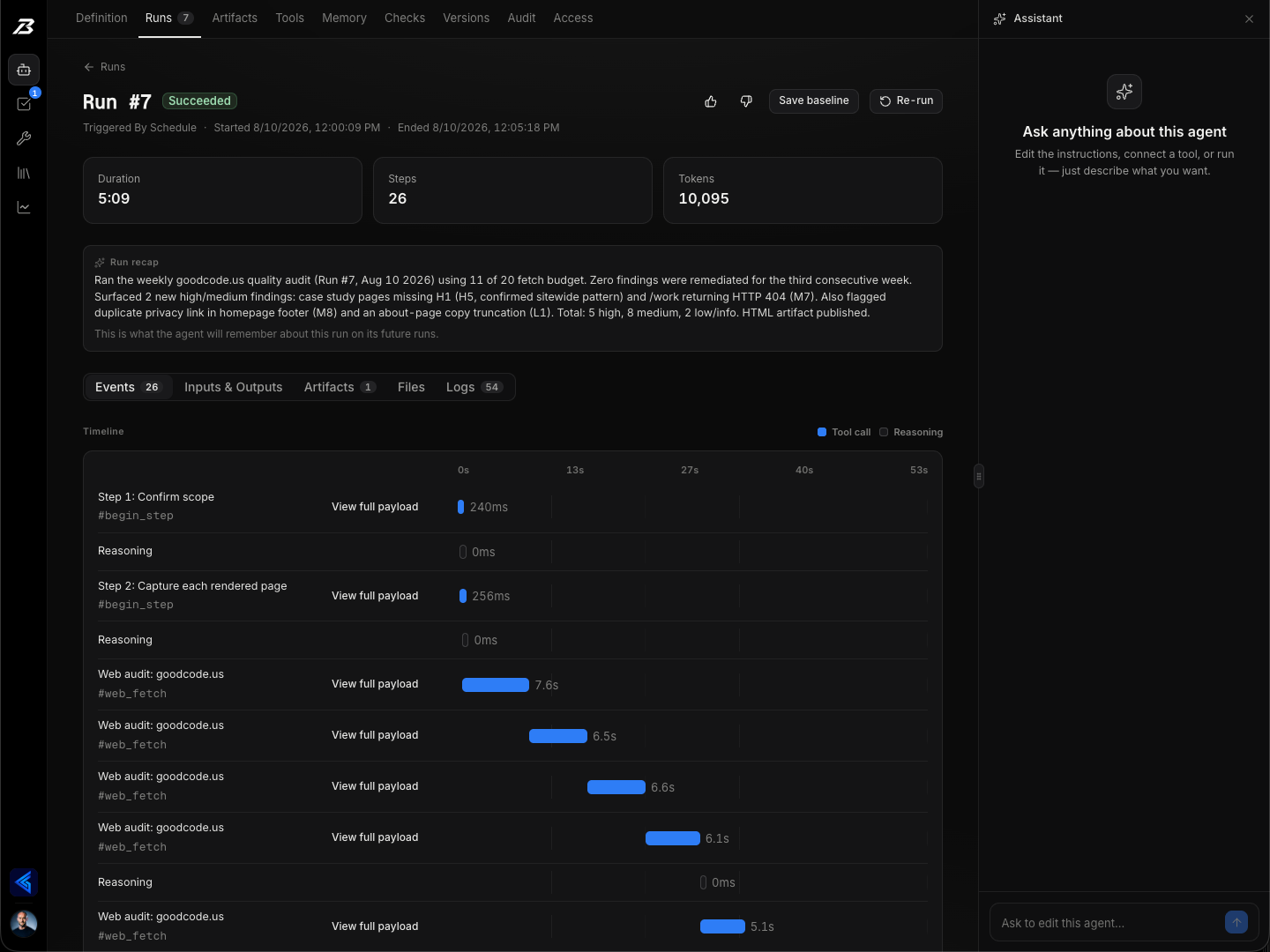
See what ran, what didn’t, what it cost, and which evidence supports completion. Keep the decisions attached to the run.
Add explicit completion requirements to structured steps. Require a saved artifact or a successful tool receipt for an exact target before the step can complete.
Follow steps and tool calls as they happen. Inspect retained request and response payloads from the run timeline.
Keep proposed actions, confirmed results, and uncertain outcomes distinct. A proposed tool call is not treated as proof of delivery.
Recognized provider failures are labeled as billing, rate limiting, or context size, with the provider’s reference ID ready to copy. A deliberate safety stop is flagged as a safety stop, with guidance, instead of reading like an error.
Settings → Logs explains why scheduled or email-triggered work didn’t start: a skipped schedule, a filtered email, a blocked run, or a schedule paused after repeated failures. Entries are kept for 30 days. It is an operations log, not a complete audit log.
Owners and admins see usage by person, trigger, and agent, and compare per-run costs.
Download summaries of an agent’s latest 100 runs for reporting and review, with a note when older runs are left out. Retained tool-call payloads remain inspectable in the console.
Review the agent’s activity timeline for recorded changes to permissions, tools, triggers, knowledge, and published definitions, with the actor and before-and-after context.
Every version stays a diff you can review and roll back. Export definitions and move between workspaces without secrets.
Recent run outcomes surface degraded or failing agents. Configured notifications bring failures, blocked runs, and approval requests to your team.
Opted-in workspace owners and admins receive an email and in-app recap of runs, outputs, approvals, and spend, with week-over-week context.
Ground the work in your sources, keep learning reviewable, and deliver files and reports your team can use.
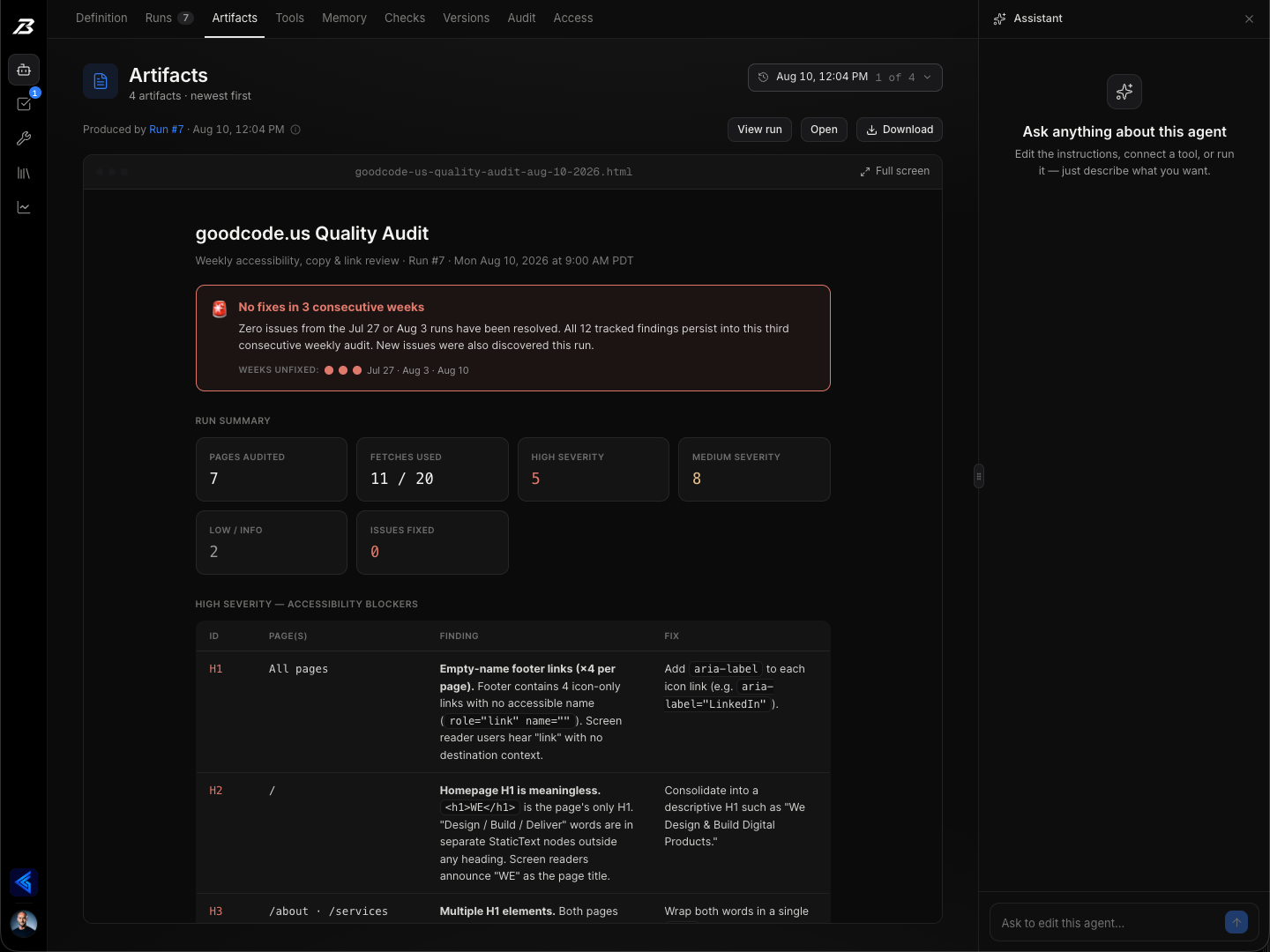
Create self-contained dashboards and reports. Keep artifacts private to authorized, signed-in workspace members, or enable a link to share publicly with end users. Run files stay workspace-only.
Index individual web pages, RSS, text, and files into searchable knowledge. Re-sync supported web sources on a schedule.
Load and inspect fully rendered public pages with native browser capabilities, without configuring an external browsing tool.
Eligible completed runs can turn experience and your feedback into lessons for future runs. Every lesson links to its source. Set inferred learning to automatic, review-first, or off.
Read and edit files from repositories named in the agent’s instructions, then open a GitHub pull request for review. Publishing changes is approval-gated; tokens stay on the platform.
Collect the CSVs, JSON extracts, charts, and other files an agent creates in one place on its run.
Saved facts, recent-run recaps, and lessons give the next run context. Inspect, manage, or download the agent’s memory as JSON; learning updates its context, not the underlying model.
Rolling outmeans the capability is built and going through production rollout checks; it may not be enabled in your workspace yet.
However work arrives, Boring applies the same scope, human checkpoints, execution controls, and reviewable record.
Other starts · 5
context assembly
policy layer
bounded runtime
evidence + operator record
Access is scoped before an action. Recovery keeps recorded progress, and a numbered plan never repeats an uncertain write automatically. Authored completion requirements check saved evidence before a step can finish.
1,500+ integrations across communication, identity, developer, CRM, data, and productivity — plus guarded first-party packs and your own OpenAPI or remote MCP tools.
Boring comes out of an AI strategy and implementation practice — the platform is how we deliver the work. Engage us white glove and we build and run your agents with you, or take the console and build directly. Same product either way.
Pick a starter playbook, check that your tools are covered, read up on where agents earn their keep, or see how this compares to the agent or workflow builder you already use.
Boring AI is the operating layer for AI work a business owns. A webhook, email, form, schedule, or app event starts an agent in a shared workspace; sensitive steps pause for an assigned teammate; and each run keeps the reasoning, tool calls, inputs, outputs, approvals, and cost together in one reviewable record.
If the work is personal, ad hoc, or yours to steer, use what your plan includes: Claude, and the personal agents now included in many AI plans, handle that well. Boring earns its place when the workflow belongs to the business. It starts from an event rather than someone's chat, lives in a shared workspace where every change is a versioned diff, acts only through the exact actions granted to it, routes sensitive steps to an assigned reviewer, resumes eligible failed runs from the last completed step, and leaves one record per run that other people can inspect. You are paying for operating and governing the workflow, not access to another chatbot.
Supervised automation runs on its own for routine steps and stops for an assigned person on the ones that matter, with the boundaries enforced by the runtime rather than written into a prompt. You describe the work in plain language instead of drawing a flowchart. The agent can call only the exact actions you granted, and new agents start with every connected action waiting for approval until you decide what to loosen. At each pause, the assigned reviewer can approve the step, modify its exact arguments, or reject it, and the decision stays attached to the run that needed it.
Use them when the work is one person's. Each gives an individual an agent with a cloud computer to work on: you message it, it keeps working on schedules, and it checks with you before risky steps. Grok Bot's Team Bots, in public beta as of October 2026, let a team share one bot, though each routine still runs for the person who set it up. Boring is for work a team owns and answers for. A known event starts the agent: a webhook, a form, a schedule, an app event, or an API call. It lives in a shared workspace with roles, and every change to its definition is a versioned diff you can roll back. Sensitive steps go to an assigned reviewer who can approve, modify, or reject them, with due dates and reminders. Eligible failed runs resume from the step that failed, and each run keeps one record the team can review, on the model and keys you choose.
Those are flow builders: you draw a fixed graph of triggers and actions, and the graph is what runs. Boring has no graph — you describe the outcome and the agent plans the steps on each run, so a renamed field or an unforeseen edge case doesn't send someone back to re-wire nodes. The trade-off is real in both directions: for simple app-to-app plumbing a flow builder is cheaper and faster to set up, and Zapier's app catalog is far larger than our 1,500+ connected tools. Boring is for the workflows with judgment in them.
New agents start with every connected action waiting for approval; owners can loosen that to writes only or auto-approve eligible actions they trust, such as reads, and an action Boring can't classify is treated as a write. When a step needs approval, the run pauses before it executes and the request waits in the shared Tasks inbox for its assigned reviewer; a tool approval leads with the exact proposed call and its secret-scrubbed arguments. That teammate — or a workspace owner or admin — can approve, modify, or reject it in the console, or approve or reject it from the native mobile companion, and the agent's owner or an admin can reassign it; an approving note returns to the agent as context before the run continues. Gates can carry due dates and reminders, and runs that remain paused in the background follow the configured reject-or-skip outcome after the deadline and grace period. Every decision and handoff stays attached to the run.
1,500+ connected apps covering the common operations stack — chat, email, CRM, helpdesk, project tracking, finance, docs — plus guarded first-party packs for selected APIs, any HTTP API that ships an OpenAPI spec once an admin reviews the imported operations, and remote MCP servers that authenticate with a token. Agents can also load fully rendered public web pages, search knowledge you've added, and run short JavaScript or Python calculations in a sandbox with no network or credential access.
New agents run on Claude Sonnet 5.5 by default, through Boring-managed models with no API key to set up. Boring-managed models also include GPT, Gemini, and Grok with no key, and lower-cost open-weight models are rolling out on the same managed route. Teams that prefer their own provider accounts can bring an Anthropic, OpenAI, Google, OpenRouter, or compatible-endpoint key instead. Set a workspace default or pin a model per agent, and backtest the change with the agent's Confidence checks before you switch. If a saved key stops working, the run stops and names the provider rather than quietly moving your traffic to Boring-managed models.
A schedule, an inbound webhook, an inbound email, a public form submission, an event in a connected SaaS app, the Chrome extension on the page you're looking at, the workspace API, an MCP client such as Claude Desktop or Cursor, or another agent. Whatever starts it, the same agent definition, granted actions, and reviewers apply, and the run is recorded in the workspace rather than in one person's chat history. When a run fails you can retry it from the step that failed rather than from the top — provided it got at least one step done; the console tells you when only a full re-run is possible.
No. Nothing is fine-tuned on your workspace and nothing is shared across agents or workspaces. Agents do learn in a narrower, visible sense: each run ends with a recap, items that repeat get de-escalated instead of re-flagged every day, and a thumbs-down becomes a standing lesson. Those lessons are memory entries you can read and download as JSON, each showing the run that taught it, and per-agent learning can be set to automatic, review-before-it-applies, or off.
Yes. Each run has a trace you can open in the console: the agent's reasoning, every tool call with its inputs and outputs, every approval and who gave it, and the cost of the run. Those tool inputs and outputs are pruned after 90 days, along with artifacts and replay payloads; the run's outcome, output, and step list stay. Reports and dashboards an agent builds are saved as self-contained pages, and each agent has one stable link showing its latest one, retained 90 days. Any files the run wrote — a CSV, a JSON extract, a chart — are listed on the run and download from there; those stay inside the workspace rather than behind a public link. Run exports (CSV or JSON) and workspace CSV exports cover summaries rather than the full step-by-step payload record, and run exports hold the most recent 100 runs. There's no immutability or attestation story yet — so this is a trace your team can review, not a compliance-grade audit archive.
We're in early access, so terms are set per design-partner engagement instead of published on a pricing page. There is no per-step meter. Ask us and we'll be specific about your workflow rather than pointing at a table we haven't earned yet.
Yes — white glove is the other half of the product. Our team maps your operations, builds the agents on the Boring platform, and runs them with you. The agents live in your workspace, written in plain language your team can read, edit, version, and roll back, so the engagement can end without the automation ending.

Request access and we'll map where the work starts, where judgment enters, and what must never happen without approval. Build it in the console or have our team operate it with you.